Code
After touring the IM lab and costume shop and spending a few days getting inspired by different ideas, our team met to brainstorm as many thoughts as we had on ways to send a secure message remotely. We initially thought of using binary to encode 37 characters which would require 7 bits (each bit having two orientations). While this seemed like the most optimized way to transfer messages through wires and over the internet, it did not take full advantage of movement, color, and different types of peripheral objects. Movement, color and the ability to use more than 2 objects meant that our code can be less simple in its character set, but each character can be represented in smaller chunks of information.
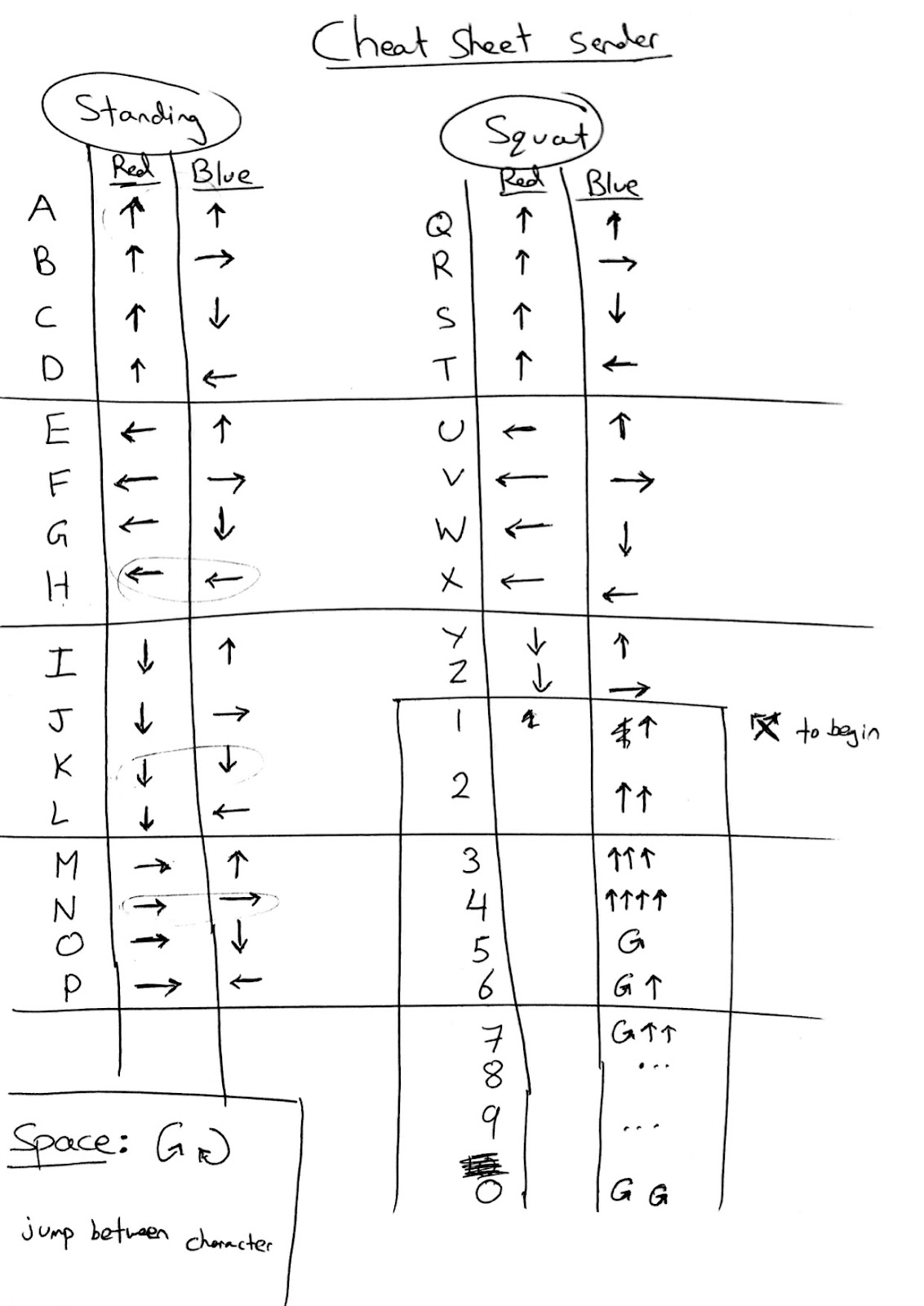
We decided to use color in our encoding as it was a very clear transferable signal. We used two wooden rods, one covered in blue tape and one in red tape. Each rod can be held in one of four positions (up, down, left, right), and the combination of the two encode a single character. This ensures clarity and gets rid of ambiguity. While many teams divided the plane to 8 equal parts, we decided to stick to 4 quarters because that made the interpretation simpler. While we knew with what we wanted to encode our data, we weren’t sure on the code itself. One initial thought was to have easier signals for letters that are the most common in English such as vowels and leaving more complex encodings to letters such as Q, Z, and X.
However, this started looking like a rule of exceptions, and so we decided to stick with the standard order of the alphabet. We also thought it was intuitive to separate the codes for numbers and letters, so we created a separate encoding system based on the Roman numeral system. The number “V” was encoded with a circular movement of the rod, and “I” was encoded with a top-to-down swing of the rod. We decided to start each digit with the crossing of the rods in an “X” shape.
Since the orientations of left and right are flipped for two people facing each other, we first thought of creating two different code cheat sheets, one for the sender and one for the receiver. This seemed unnecessarily complex, so we instead decided to continue with a single encoding system, and have the sender face their back towards the receiver instead. To solve the problem of separating each character, we decided to use jumping to signal to the receiver that they can move to the next character. This way the receiver knew that the transmission of one character was over.
We also thought, why not make this form of communication a part of a healthy, active lifestyle, and so we included two different starting positions: standing and squatting. (These combined with the jumping created a way of communicating with crossfit). These two starting positions + the red and blue rods + the four positions for the rods gave us a total of 32 possible characters for the letters.
The Day of The Competition
Adam’s Perspective
We got to the Arts Center lobby with hopes of getting the message through. We could feel the pressure transmitted (pun intended) by our classmates who just as prepared to send some messages as we were.
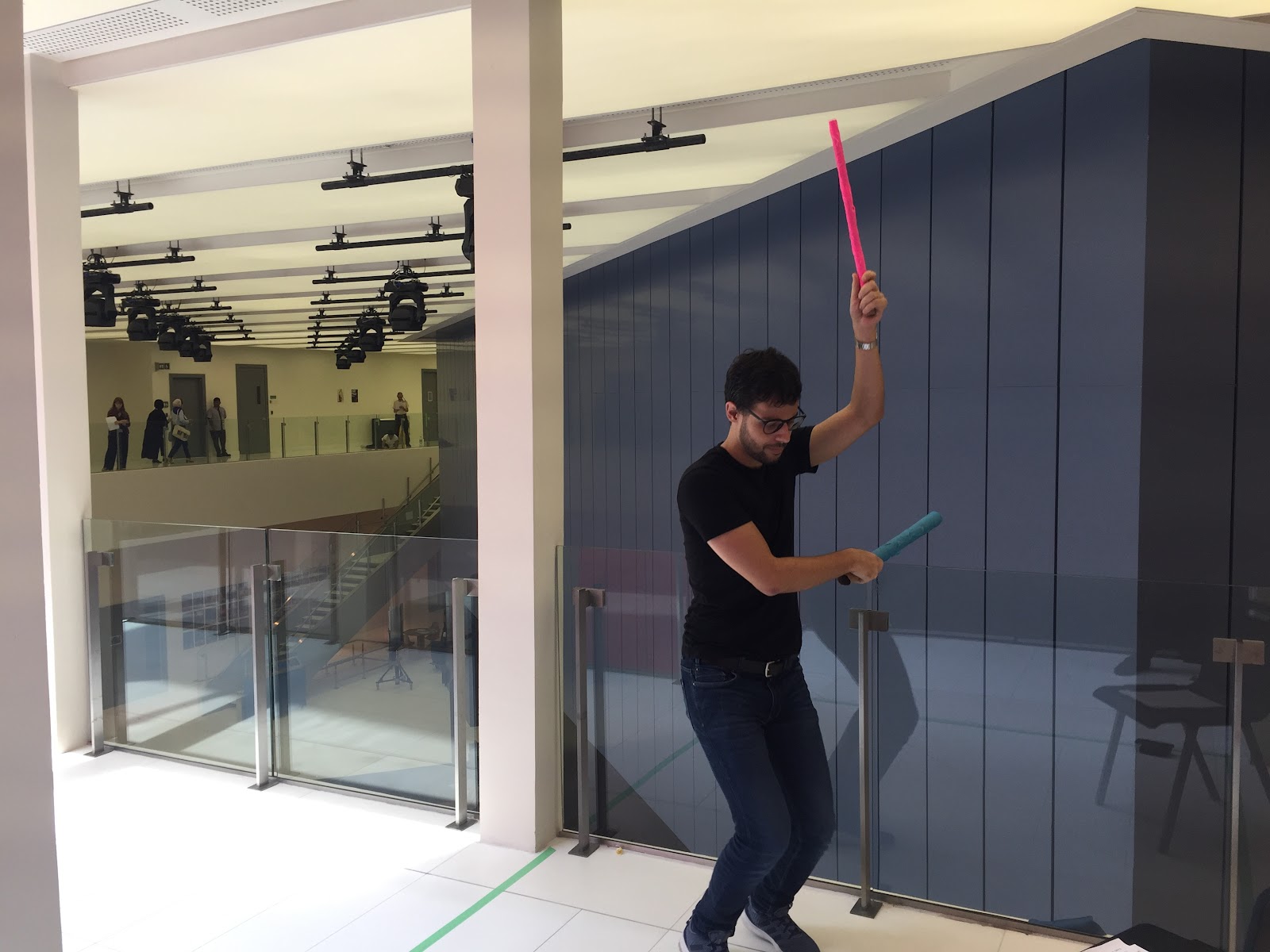
My biggest concern was not that I wouldn’t be able to finish the message but that I would skip a space or that Sohail wouldn’t see the sign as I am squatting. Since we didn’t mirror the code to avoid confusion of direction, that actually worked against us: as a transmitter I did not have any visual feedback of Sohail being able to receive the message or not. I had to make sure during the setup that his view was not blocked by any of the columns and that he can even see the signals that I showed to him while squatting.
On the other hand since the need for visual feedback was eliminated and we implemented the “jumps” to divide each character, I got through the message surprisingly fast. Later our classmates told us that they did not even notice me sending the code, they only realized that the message was sent as we got down the stairs. I was able to transmit a letter every 3-4 seconds, coupling that with the spaces the 40 character code went through in around 2 minutes. The efficiency of transmitting and the fact that the sending went unnoticed proved that the code was secure to use and hard to decode.

Sohail’s Perspective
We practiced a few times before where I was the receiver, but we were still hoping that the code would work over the long distance across the Arts Center lobby. The few times that we practiced, we also finished encoding and decoding the message very close to six minutes, so we felt pressured to go through the characters as quick as possible. Since I didn’t have a hard surface to write on, I sat on the floor instead, which made it a bit difficult to see because of the glass.
As the receiver, I also did not have enough time to decode each character in real time, so I just hoped that I had enough time at the end of the six minutes where I went and decoded the symbols one by one. We added a minor addition before the competition where Adam would jump to indicate a new character. This helped me not lose track of the message, especially as I constantly looked down to my paper and back up again.
As soon as the stopwatch started, I noticed that it was difficult to clearly see the blue rod when Adam was squatting, because it was blocked by one of the pillars. I didn’t want to waste any of our precious time so I just made a note of the ambiguity on my sheet. At the end of transmission, the sentence I had down was “Prerident wins by 8 votes”, so it was easy to notice my mistake.
