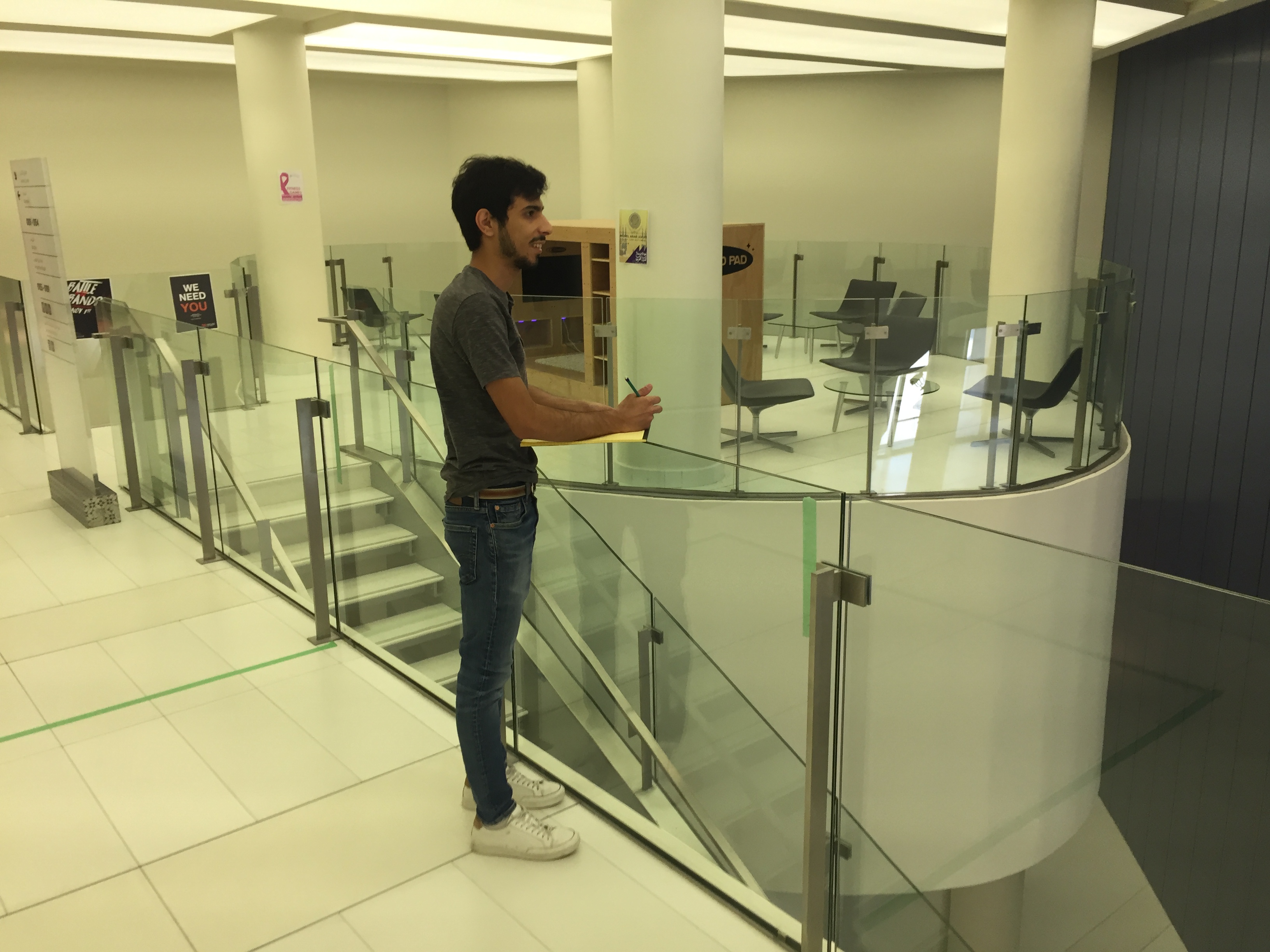
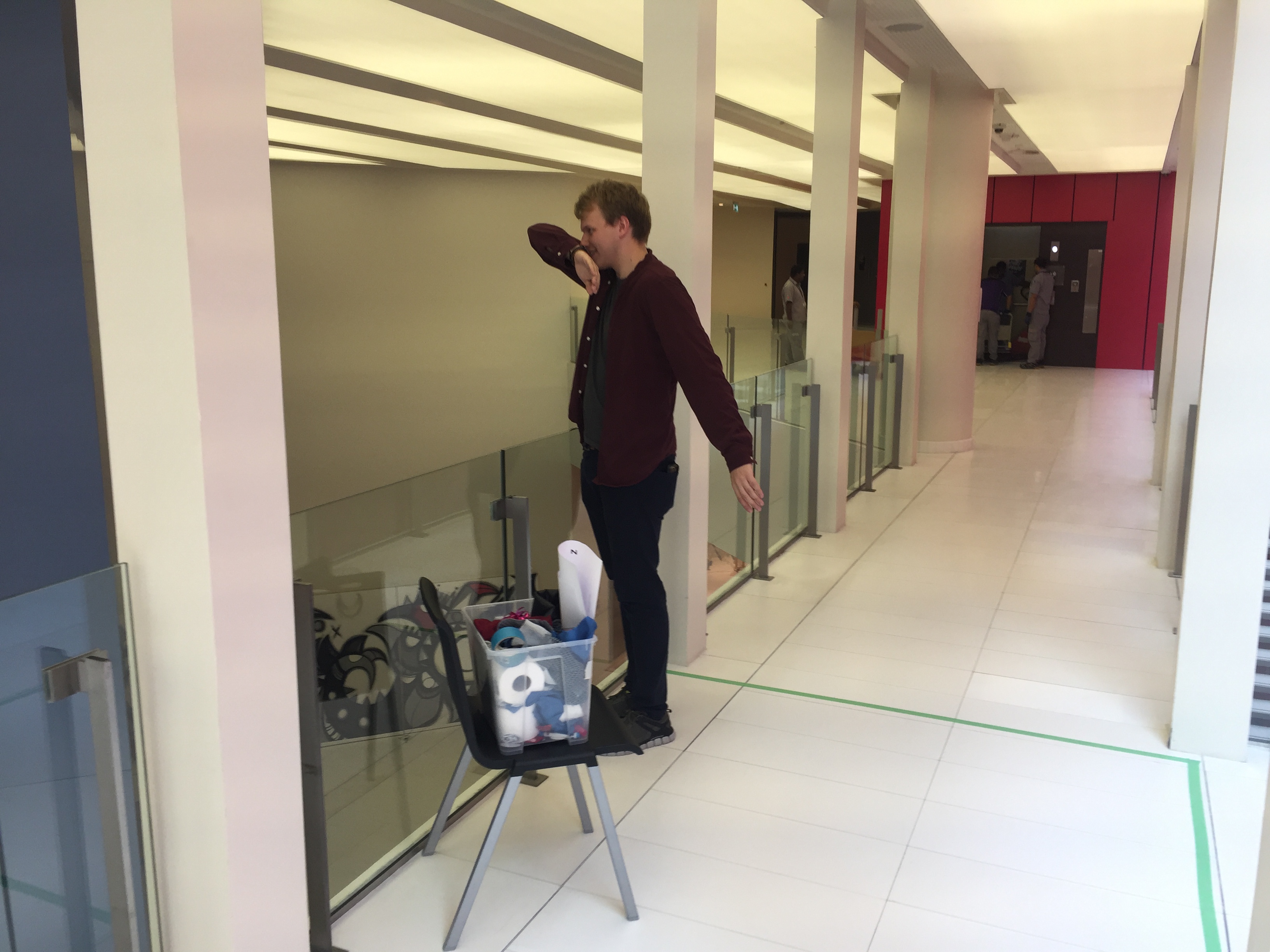
With our entry in the semaphore competition, we tried to solve the global issue of young people not communicating with each other in person. We hypothesized that one reason why nobody has managed to solve this is that adults are trying to press their means of communication upon the kids. Meaning, adults want kids to talk using words. However, we believe that utilizing the technique dabbing is the way to proceed.
Our semaphore system did not start out with the arbitrary idea of dabbing, but it was more of a natural progression of ideas. We first wanted an intuitive framework upon which we can build our final system. We had conversations about avoiding one-to-one correspondence between a code and the letter it represents, whether we want to sacrifice creativity for efficiency, and the significance of mental associations to make things easier. From the start, we did not want our code to rely on a piece of paper for deciphering, but rather on the receiver’s visual/mental intuition. Our first few ideas involved utilizing a mirror/light combination, acting out scenarios corresponding to each letter, and using the four corners of the sender box to signify a different ‘mode’ of sending. All of these did not meet our criteria so we scrapped them.
We ended up using an already-established character grouping system, the old phone keypad. It was perfect for our purposes, as it allows both the sender and the receiver to have a mental map of the system they’re using without a piece of paper to guide them. We then moved on to the challenge of physically representing this code. We had many ideas that would utilize objects, but ultimately we decided that our system would become too obvious. Instead, we decided to use our bodies. We went through many iterations before settling on dabbing, not only because it’s a fad but because it, like the phone keypad, represents a popular concept that is recognizable and was once cool (but now really isn’t), suitable for the receiver’s ease of mental recognition.
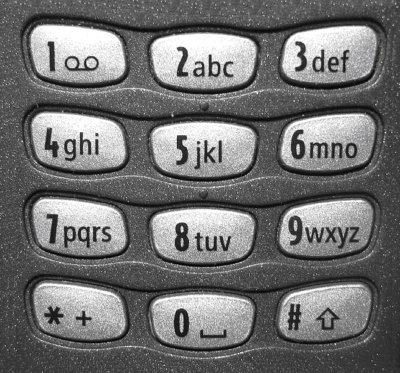
Old phone keypad. 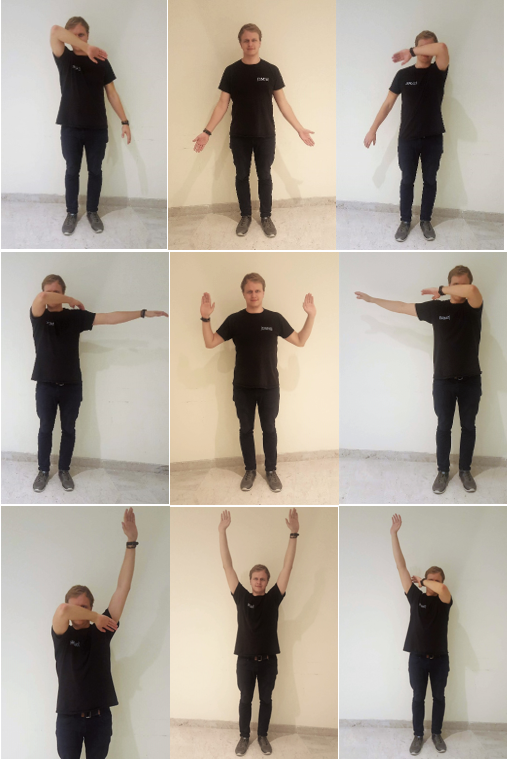
Raitis (sender) movements corresponding to old phone keypad sets (mirrored).
We settled on a simple system: the arms represent the screen, and the head represents the presser (like the thumbs when texting). When Raitis (the sender) wants to represent a certain block, say abc2, he would lower his arms so his head (the presser) is at the top of the “screen”, then nod his head a certain number of times to indicate a specific character, like 3 nods for ‘c’. The dabs were used for the side blocks, as they clearly marked the side meant by the sender to the receiver. One difficulty presented by this system was the fact that it was mirrored for Hani (the receiver), who had to mentally flip the side of Raitis’s head. For spaces, a simple space bar movement with the arms was used, and for 0, the “Wakanda forever” move was used in the spirit of fads. For repeats, Raitis would raise his arm before repeating the move.
The last part of our system is a skipping movement, used for when the character indicated is obvious and can be guessed by the receiver by context. For example, for the word “perfect”, the sender could spell out “perfec” and do the skipping movement for the last character, which the receiver would then guess to be a ‘t’.
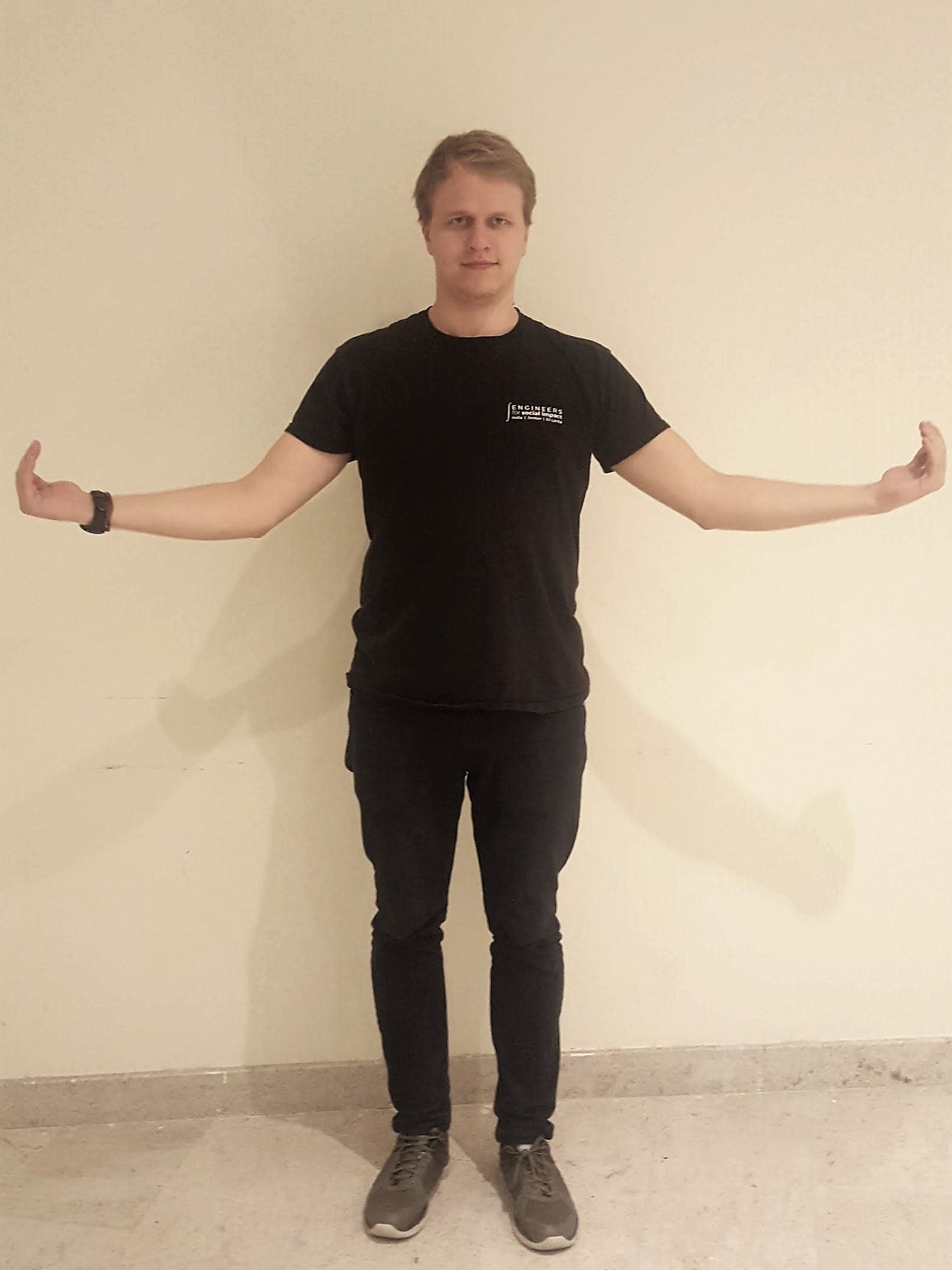
Space bar move. 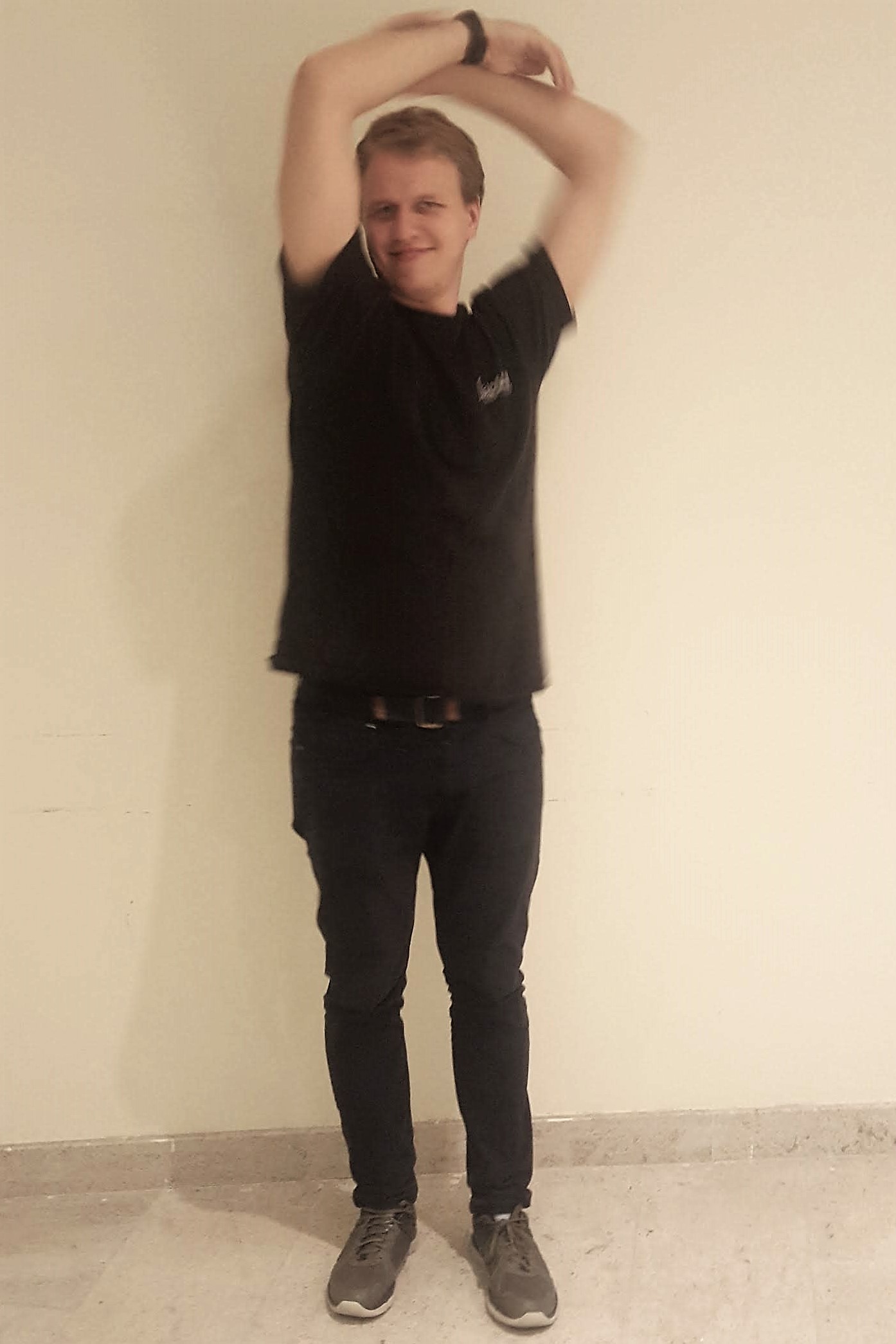
Skipping move.
Our system, while tricky to master initially, was fast and efficient after some practice (3 minutes for 40 characters). We realized that it relied heavily on the sender and receiver and was prone to some error, so practice was a must. In addition, we could easily employ error correction in the case of sending wrong characters, as most errors were a result of the receiver (Hani) failing to mirror the message, and simply mirroring the wrong character again would fix it. Unfortunately, there wasn’t any time given to error correction after sending the message in the competition, and we were slower and less accurate than we anticipated. However, we still believe that this attempt at visual/mental association offers a promising basis for semaphore communication, as it is quick to grasp, obscure enough to hide, and only requires arms.